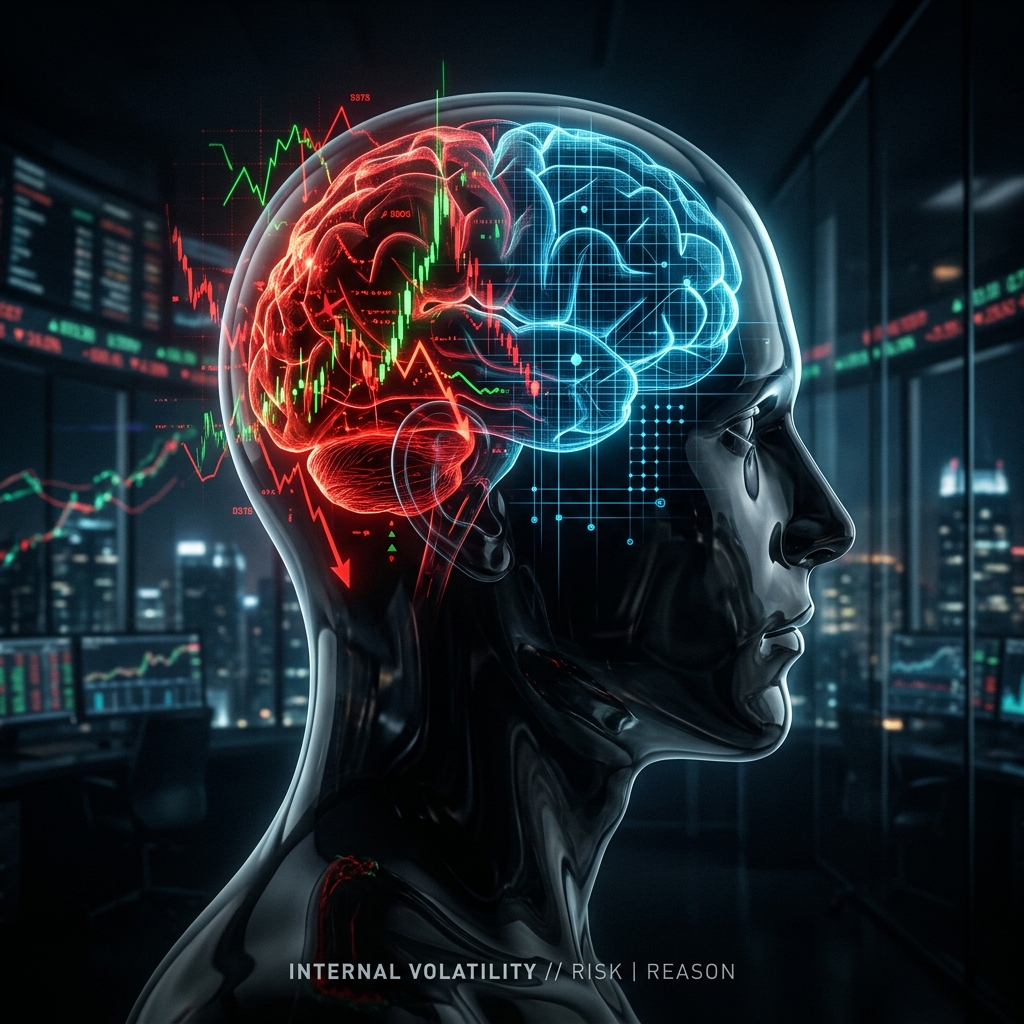
I. The Terminal Drawdown of the Soul
Most people don't lose money because they're stupid. They lose it because they're still playing fair in a game that laughed at fairness years ago.
The banks have spent decades engineering a single, devastating illusion: that the market is a level playing field where effort, patience, and "doing the right thing" will eventually be rewarded. "Stay the course." "Don't time the market." "It'll come back eventually." These aren't pieces of investment advice. These are moral imperatives disguised as wisdom. They are guilt trips with compound interest. And every time you nod along, you're not playing fair—you're being politely mugged. The banks don't need to rig prices anymore. They rigged your conscience instead.
You can have perfect entries, flawless risk management, a beautifully coded algorithm, and still wake up poorer every single year. You sit there staring at your portfolio—green candles everywhere, moving averages perfectly aligned, the Level 2 data humming along exactly as your macro thesis predicted. By all external metrics, you should be winning. But when you step away from the terminal, the P&L of your actual life feels like it is in a terminal drawdown. The hours evaporate. Your cortisol is permanently spiked. You are exhausted before the opening bell even rings.
You naturally assume the market is beating you. You assume the algorithms hunted your stops, or that institutional block orders front-ran your position. You think you need a better screener, a faster data feed, or a more complex options strategy to finally get ahead.
You don't. The market isn't beating you. The market didn't take your money. You did.
And you did it slowly, quietly, one scattered, dopamine-seeking, anxiety-riddled decision at a time.
In the retail world, volatility is just a scary line on a chart. It is an external force that happens to them. Legacy brokerages actively design their user interfaces with flashing red and green lights to ensure you view volatility as an unavoidable roller coaster you simply have to ride. But the professionals—the ones who actually hold onto their capital across decades—know that market volatility isn't the primary threat. Your behavioral volatility is.
You are experiencing a systemic, slow-burn theta decay on your own sovereignty. It is the σ (sigma) of your own mind under pressure. Right now, if you are trading out of boredom, trauma, or exhaustion, your internal volatility is eating your time-value like a starving gamma scalper.
You spend hours analyzing the balance sheets of distressed micro-caps, but you absolutely refuse to audit the massive, bleeding liability sitting in your own chair. The "Impulsive You" is executing trades off-book, bypassing the internal compliance department you spent years building. You are demanding justice and fairness from an indifferent chaos engine.
It is time to stop subsidizing the industry with your emotional dysregulation. It is time to stop looking at the screen and start measuring the metric that is actually determining your net worth.
Welcome to your Internal VIX.
The VIX measures market fear. Your "internal VIX" measures your fear — the ambient anxiety that decays your life the way theta decays an option's value. Every day you spend in a state of financial anxiety, you're losing time-value you never get back. The fix isn't making more money. It's building a system boring enough that your internal VIX drops to a level where you can actually live, think, and compound in peace.
II. Missing Signal: The "U Up?" Trade and Financial Attachment
Before we measure your Internal VIX, you must understand who is monetizing it. To cure the disease, you have to look at your financial attachment style. Let's skip the technical analysis and perform a clinical audit of your behavioral hardware.
You tell yourself you're "actively managing risk." You tell yourself you're "staying on top of the macro trends." But let's look at the telemetry data. You check your brokerage app 40 times a day. You feel a physical jolt of cortisol when a position moves 0.5% against you. You revenge-trade at 3:45 PM to "make back" losses because your brain cannot tolerate sleeping on a red P&L.
That isn't an investment strategy. That is a trauma response.
The financial industry loves to talk about "Risk Tolerance" as if it were a sterile number on a questionnaire. It is not. Your trading behavior is a textbook manifestation of an Anxious Attachment Style, seeking daily emotional reassurance from a market that is structurally, ruthlessly Avoidant.
You buy zero-day options (0DTE) or speculative meme stocks not because you've built a rigorous discounted cash flow model, but because you need a neurological hit. You are buying directional hope (Delta) because you need the market to text you back immediately. I call this the "U Up?" trade.
But here is the hard truth your amygdala refuses to accept: The market does not care about you.
The market is the ultimate Avoidant partner. It is a merciless, efficient pricing engine calculating intrinsic value. It has no memory of your cost basis. It does not know your kids need braces. It operates on a logic of absolute indifference and chaos. When you try to "time the bottom" or "force a trade" while your internal variance is flashing red, you are trying to demand intimacy from a sociopath.
The more you chase it—over-trading, chasing rallies, leveraging up to win it back—the more it financially pulls away from you through theta decay, slippage, and whipsaws. You are paying an anxiety premium for a relationship that exists entirely in your head. You are bringing a bouquet of roses to an algorithmic knife fight, desperate for a hug from a volatility machine designed to strip-mine your dopamine.
III. What the F*ck Is Internal VIX? (The Forensic Audit)
Let's strip the romance out of psychology and treat it like the clinical math problem it is.
Your emotional state isn't a mystery, your "gut feeling" isn't an alpha-generating oracle, and your burnout isn't an abstract feeling. They are a measurable, quantifiable data set.
Inside SomedayFi, the Internal VIX engine doesn't ask you how your day was. It doesn't care if you feel validated by your peers. It runs a sterile, clinical, five-question audit of your behavioral friction — five forced-choice scenarios drawn from a battery of cognitive-bias traps, each scored on a strict 1–4 scale.
Here is the critical institutional distinction: We don't care about the sum. We care about the variance.
The algorithm calculates the population standard deviation (σ) of your answers. Why standard deviation? Because absolute scores can be manipulated by your ego, but variance cannot hide. A trader who is consistently, mildly exhausted is actually a predictable operator. You can plan for that. The danger lies in the spread. The danger is the violent oscillation between the cold logic of your "Fiduciary You" and the manic, dopamine-starved chaos of your "Impulsive You."
No fluff. No therapeutic noise. Just the raw, mathematical spread between your baseline discipline and your current psychological chaos. This calculation acts as a ruthless mirror, forcing you to confront the numerical reality of your operational state.
Here is the methodology box exactly as it appears in the engine:
- σ ≤ 0.5 = Stone-Cold Operator. Your variance is exceptionally tight. The data confirms that "Fiduciary You" is at the helm. You are acting with absolute mechanical precision, devoid of emotional noise. You are authorized to deploy capital because your internal risk parameters are functioning flawlessly. You are Securely Attached to your capital. You are the underwriter, the casino owner, the landlord collecting rent.
- 0.6 ≤ σ ≤ 1.4 = The Degradation Zone. You are slipping. You are leaking cognitive capital. You are beginning to justify small rule-breaks. "Just this once." "I have a gut feeling." You are slowly transitioning from the systemic farmer back into the emotional hunter. Proceed with extreme caution and halve your position sizing.
- σ > 1.5 = Behavioral Circuit Breaker. Your internal market is crashing. The "Impulsive You" has hijacked the terminal. At this level, self-directed capital deployment is strictly contraindicated. You are legally, mentally, and financially forbidden from touching your own money until the volatility subsides. You step away from the desk, or you accept that you are willfully, voluntarily burning cash to soothe your ego.
Audit Your Internal VIX (σ) in Real Time
Put your behavioral hardware through the 5 forced-choice scenarios. Compute your personal σ, inspect your variance spread, and visualize the 30-year compounded wealth extraction on your balance sheet.
Launch Internal VIX Audit →IV. Theta Decay, But Make It Human: The Behavioral Greeks
To understand why an elevated Internal VIX is actively destroying your net worth, you must stop viewing the options Greeks as mere mathematical inputs for pricing derivatives. The Greeks are the underlying architectural blueprints of human behavioral biases. To master your personal P&L, you must map these clinical market Greeks directly onto your own behavioral engine.
Delta (Δ): Directional Hope and the Dopamine Tax
In options, Delta is your directional exposure. In your life, Delta is your addiction to the dopamine hit. You buy options out of the money or chase meme stocks not because you've done the math, but because you need a neurological spike. You want the thrill of being right immediately. When your Internal VIX is high, you are desperately chasing Delta. You are paying a massive, systemic fee just to feel alive for 45 minutes. The average lottery-ticket trader is simply paying a massive premium for the excitement of Delta, while the informed analyst is focused on collecting the premium. Every time your Impulsive Self takes the wheel, you are overpaying for Delta.
Theta (Θ): The Time Decay of Sovereignty
In the markets, Theta is the silent thief—the inevitable erosion of extrinsic value as the clock ticks toward expiration. It operates 24/7, weekends and holidays included. In your life, Internal Theta is the daily tax levied on your sovereignty. Every day your σ stays elevated, you lose "time value" on your decision-making capital. Your cognitive bandwidth evaporates, leaving you exhausted before you even review a chart. Every minute you spend doom-scrolling financial news or revenge-trading to "make it back" before the close is a manifestation of internal theta decay. You aren't just losing time; you are losing the value of that time. You are bleeding out your potential because the internal noise is consuming the baseline caloric energy required to execute your edge.
Vega (ν): Sensitivity to the Noise Factory
Vega measures an option's sensitivity to implied volatility. Your Internal Vega measures your emotional reactivity to noise. High Internal Vega means you lack an emotional firewall. A single red macroeconomic candle, a sensationalist headline, or a sharp text from a boss causes your σ to violently spike. The entire Media-Entertainment Complex is designed to exploit your Vega. They want you permanently "engaged," sweating over arcane concepts and geopolitical doom, because your anxiety is their revenue stream. When your internal Vega is elevated, your discipline shatters. You become hypersensitive to the chaos megaphone, guaranteeing you will buy at the absolute top of a manic rally and panic-sell at the exact, punishing bottom of a localized dip.
Gamma (Γ): The Stress Snap and the Megaphone Effect
Gamma is how fast your behavior cracks when Delta moves against you. It's the rate of change of your own panic. It's the stress spike that turns a minor, manageable 2% drawdown into a sudden, catastrophic P&L blow-up. A sudden "Biological Circuit Breaker" event is a gamma explosion where your rational firewall fails completely. This is where Leverage enters the chat as a behavioral weapon of mass destruction. Leverage is the financial megaphone. It does not make your investment thesis any smarter; it just clicks the volume knob from 1 to 10. If your Internal Gamma is high, and you apply leverage, you turn a quiet internal whisper of doubt into a deafening, portfolio-obliterating margin call. You crystallize a temporary paper loss into a permanent impairment because your hardware couldn't handle the acceleration.
VRP (Volatility Risk Premium): Paying the Casino
In the institutional markets, the VRP is the well-documented mathematical reality that the market consistently overprices fear. Implied volatility is almost always higher than realized volatility. The institutional edge is selling that premium to the terrified masses. You want to be the house collecting the VRP. But if your Internal VIX is elevated, you aren't the house collecting the premium. You are the sucker paying the premium to your own shadow. That $400 impulsive trade last Thursday wasn't bad luck. It wasn't a "market correction." It was behavioral theta decay manifesting as a leaky pipe. Because your internal compliance department was asleep at the wheel, you paid a massive premium for the illusion of control. You handed your hard-earned capital directly to an institution that was more than happy to underwrite your panic.
Simulate Theta Bleed vs. The VRP Cushion
Want to see how internal volatility maps directly to financial market mechanics? Test real-time option prices, visualize non-linear Theta decay curves from 60D down to 0DTE, and model what happens when Implied Volatility collapses.
Launch Scenario Simulator →V. The Silent Compound Bleed: Jungian Shadow Math
Let's run the forensic receipt of your indiscipline.
We need to strip away the rationalizations and look at what your dysregulation actually costs. When your Internal VIX runs hot, you aren't just losing the money you gamble away today. You are actively destroying the future compounded value of that capital. The human brain is terrible at understanding compound interest, but it is utterly blind to compound destruction.
Enter the shadow work. Famed psychologist Carl Jung called it the "Shadow"—the repository of all the parts of yourself you have rejected: your fear, your need for validation, your profound anxiety about failure. Traders don't read Jung; they just call it "revenge trading." SomedayFi just calls it σ.
Every time you spend money or allocate capital to 'feel' something—whether it's validation from a Subreddit, a manufactured sense of safety via a new gadget, or a spite-trade to win back yesterday's losses—you are simply feeding the pathetic, hungry beast residing in the basement of your psyche. SomedayFi isn't here to meticulously count your pennies; it's here to act as a mirror. It points directly at the beast and says, "I see you. You are not executing a macro-thesis; you are purchasing ten minutes of temporary reprieve from the crushing, existential feeling of failure."
Let's run the numbers through SomedayFi's 7% opportunity-cost calculator. If you operate with a 1.2 σ average over three years, you are perpetually making sub-optimal, high-friction trades to satisfy your dopamine receptors. You are treating the market like a slot machine to regulate your own internal chaos. You buy when you feel manic; you sell when you feel terrified.
In the financial industry, we know that a parasitic 1.5% wealth management fee compounded over 40 years will mathematically steal roughly 48% of your entire nest egg. It is a $70,000 to $700,000 cover charge for a party you weren't even invited to, depending on your principal. But what is your personal behavioral fee?
If your high Internal VIX causes you to underperform a boring benchmark by just 2% a year due to over-trading, bad market timing, and paying the VRP to institutions, you are literally charging yourself an exorbitant, self-inflicted fee. When that behavioral drag is compounded against what that capital could have earned in a disciplined, mechanical, algorithmic strategy, that daily "leaky pipe" turns into a six-figure lifetime leakage.
Look at the SomedayFi dashboard. Read the exact, merciless line from the app when your audit fails:
"Your shadow just cost you $114,200 in foregone dry powder."
You are voluntarily burning the very liquidity you need to buy your freedom. You are extending your working years, sacrificing your time, and remaining shackled to a desk because you cannot stop subsidizing the financial entertainment complex with your own emotional trauma.
VI. The Operational Directive: Run the Audit
You have spent your entire investing life obsessing over the market's implied volatility, blissfully ignoring the catastrophic theta decay happening inside your own decision engine. It is time to stop subsidizing the industry with your emotional dysregulation.
The market is an indifferent chaos engine. It does not care about your feelings, and neither does your ledger.
Here is the protocol:
- Read your σ like a 0DTE position. If your Internal VIX spikes above 1.5, step away from the desk immediately.
- Deploy the emotional firewall. Use the SomedayFi Compliance Desk to sever the stalker loop. Let the algorithm act as the straitjacket your "Fiduciary You" needs.
- Apply the 7 Rules of Precise Justice. Pre-commitment exits, narrative audits, position caps — every rule is an enforceable hedge against your own shadow.
- Re-audit weekly. Watch your σ trend line flatten out like a meticulously hedged book. Every drop in your behavioral variance is capital preserved from the void.
There is no appeals court. There is only the mirror. And the mirror doesn't negotiate.
The market doesn't care about your feelings. Neither does your ledger. Neither should you.
Your wallet is a crime scene. We're just handing you the forensic kit. Run your first Internal VIX audit now. The crime scene is already open.
Step off the ride. The air is radically, refreshingly better out here.
Welcome to the Asymmetrical Life.
Run your first Internal VIX audit now →
This article is Part III of the Sovereignty Progression: